Application Scope:
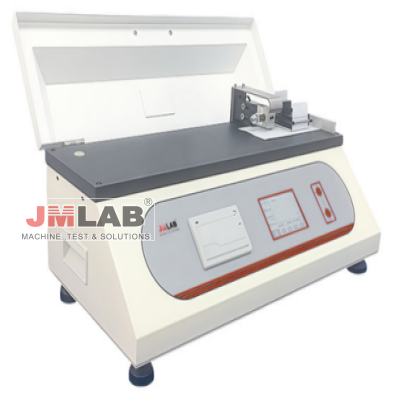
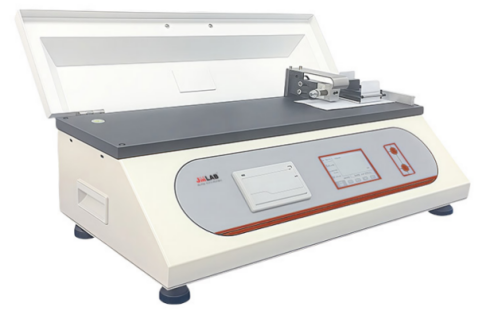
The JM-COFT01T friction coefficient meter is suitable for determining the static and dynamic friction coefficients of products such as plastic films, sheets, aluminum foil, paper, paper-plastic composite films, cardboard, and artificial skin. It is widely used in industries such as papermaking, packaging materials, and quality inspection centers.
Product Images | Product Name | Scope of application |
| plastic film | Used to measure the static and dynamic coefficients of friction of plastic films and sheets, meeting national standards, American standards, ISO standards, etc. |
| Plastic composite film | Used to measure the surface smoothness of composite films, coated materials, and paints. |
| Paper | The static and dynamic coefficients of friction of paper and paperboard are measured. |
Test Principle:
A friction coefficient meter is used to test the friction coefficient of two materials. One material is laid flat on a test platform, and the other is fixed on a slider of a certain weight. The two test surfaces are placed together, and under a certain contact pressure, the two surfaces are moved relative to each other. The required frictional force is recorded. The coefficient of friction is obtained by dividing the measured force by the weight of the slider.
Main Features:
• Supports GB and ISO standard method testing
• Supports various non-standard testing methods, making it a valuable tool for scientific research and materials studies.
• One-click operation, simple and convenient, learn and learn immediately.
• Embedded software, flat design, intuitive, and easy to operate
• Energy-saving design, ultra-low power consumption
• High-precision imported sensors ensure high accuracy, stability, and repeatability of test results.
• Supports button and screen touch operation
• Supports quality testing of arbitrary sliders
• Supports testing of specimens of any thickness
• The LCD displays the results, parameters, and test curves.
• Embedded computer control ensures accurate and efficient testing.
• Built-in statistical analysis functions for values such as magnitude, mean, and standard deviation.
• Historical data storage, with built-in historical data query and printing functions.
• Static friction coefficient and dynamic friction coefficient test
• Standard testing speed; non-standard speeds can be customized.
• Built-in mini printer enables real-time, historical data, and report printing.
• Multiple mechanical and electrical protection functions
• Configure a standard serial communication port and utilize specialized computer software to extract value from experimental data.
• Supports Ethernet communication for convenient data networking.
• Supports laboratory data management systems, enabling unified data management (optional)
Technical Specifications:
Project Name | Specifications |
Test range | 5N, 10N, 30N (optional) |
Test accuracy | 0.2%FS |
Support itinerary | 330mm (customizable) |
slider mass | 200g, 500g |
Test speed | 0-1000mm/min (adjustable) |
Sample height | 0~30mm |
power supply | AC 220V / 50Hz / 1 PHASE |
power | 100w |
External dimensions | 640mm (L)x 300mm (B)X190mm (H) |
net weight | 22kg |
Test Standards
• GB 10006-1998 Determination of the coefficient of friction of plastic films and sheets
• ISO 8295-1995 Plastics—Films and sheets—Determination of coefficient of friction
• ASTM D 1894-01 Test methods for static and dynamic coefficients of friction of plastic films and sheets
• Static friction coefficient of TAPPI T816 corrugated and solid fiberboard
• Free Mode
Standard Configuration:
Main unit, mini printer, color touchscreen, 200g slider, 500g slider
Optional accessories: software, communication cable, non-standard slider, calibration accessories, expansion modules, laboratory data management system
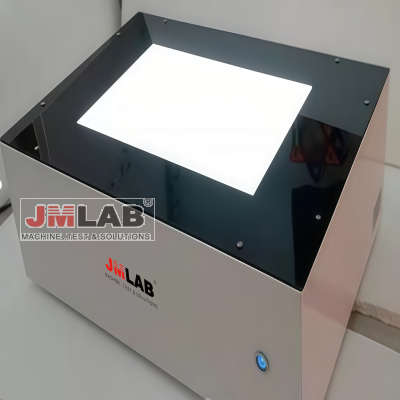
JMZK-03 Pinhole Detection Station
More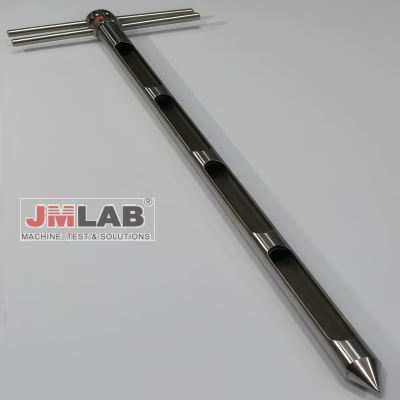
JM-YQ35 Sampler (with sampling bottle at...
More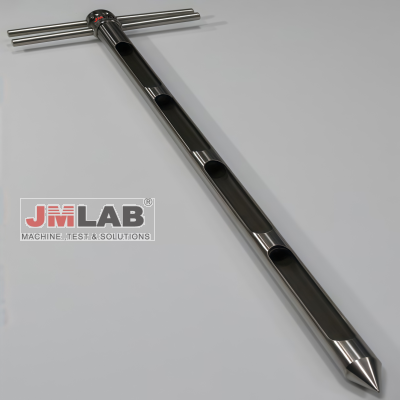
JM-YQ3 API Sampler
More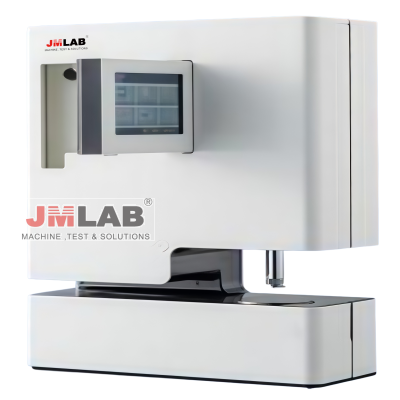
JM-YCCH01 Fully Automatic Computerized T...
More
JINAN JMLAB INSTRUMENT CO., LTD. specialized in R&D, production, OEM of testing equipments. It has been engaged in metal and non-metal testing for more than ten years, and is also proficient in various non-standard instruments. Production, research and development, upgrading and transformation of automated instruments, etc. Since the establishment of the company, the products have won high praise from domestic and foreign customers. The equipment conforms to ASTM, JIS, ISO, IEC, UL, GB, and other relevant testing standards .